
1. Safety and Precautions
Streszczenie: Zasady bezpieczeństwa falownika KE600: definicje ostrzeżeń, środki ostrożności od instalacji po konserwację oraz uwagi dotyczące silnika, warunków pracy i utylizacji.
EN: KE600 inverter safety: warning definitions, precautions from installation to maintenance, and notes on the motor, operating conditions and disposal.
Dotyczy: falownik wektorowy z zamkniętą pętlą Micno KE600 (zasilanie 3AC 220 V, 3AC 380 V, 3AC 660 V; moce 1,5–630 kW)
Źródło: dokumentacja producenta (Micno KE600 Series Inverter User Manual)
Safety definition:
Definition
In this manual, safety precautions are classified as follows:

equipment loss or personnel injury.

During the installation, commissioning and maintenance of the system, please make sure to follow the
safety and precautions of this chapter. In case of a result of illegal operations, caused any harm and losses is nothing to do with the company.
1.1 Safety Precautions
1.1.1 Before Installation:
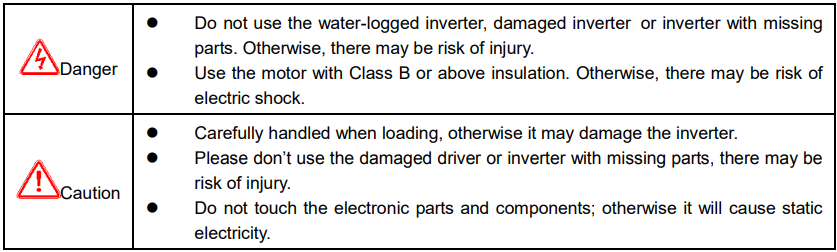
DANGER:
• Do not use the water-logged inverter, damaged inverter or inverter with missing parts. Otherwise, there may be risk of injury.
• Use the motor with Class B or above insulation. Otherwise, there may be risk of electric shock.
CAUTION:
• Handle carefully when loading, otherwise it may damage the inverter.
• Do not use the damaged driver or inverter with missing parts, there may be risk of injury.
• Do not touch the electronic parts and components; otherwise it will cause static electricity.
1.1.2 During Installation:
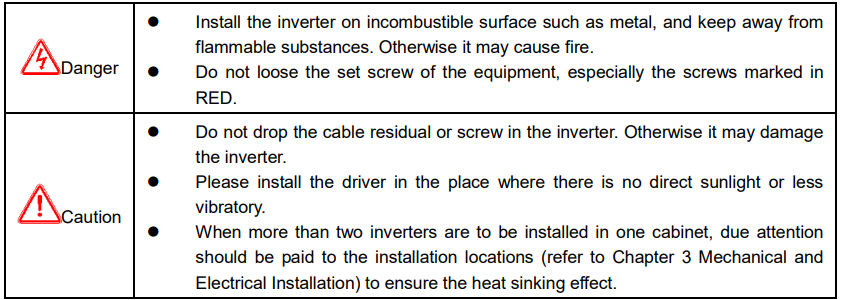
DANGER:
• Install the inverter on incombustible surface such as metal, and keep away from flammable substances. Otherwise it may cause fire.
• Do not loosen the set screw of the equipment, especially the screws marked in RED.
CAUTION:
• Do not drop the cable residual or screw in the inverter. Otherwise it may damage the inverter.
• Install the driver in a place where there is no direct sunlight and less vibration.
• When more than two inverters are to be installed in one cabinet, due attention should be paid to the installation locations (refer to Chapter 3 Mechanical and Electrical Installation) to ensure the heat sinking effect.
1.1.3 During Wiring:
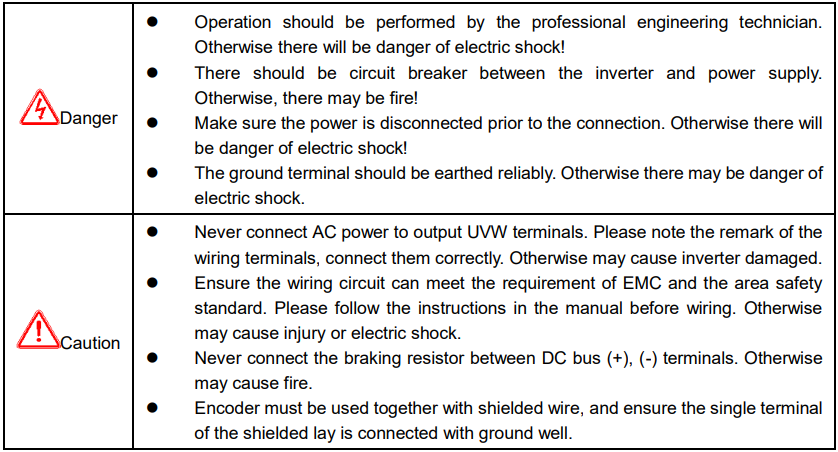
DANGER:
• Operation should be performed by the professional engineering technician. Otherwise there will be danger of electric shock!
• There should be a circuit breaker between the inverter and power supply. Otherwise, there may be fire!
• Make sure the power is disconnected prior to the connection. Otherwise there will be danger of electric shock!
• The ground terminal should be earthed reliably. Otherwise there may be danger of electric shock.
CAUTION:
• Never connect AC power to output UVW terminals. Please note the remark of the wiring terminals, connect them correctly. Otherwise it may cause inverter damage.
• Ensure the wiring circuit can meet the requirement of EMC and the area safety standard. Please follow the instructions in the manual before wiring. Otherwise it may cause injury or electric shock.
• Never connect the braking resistor between DC bus (+), (-) terminals. Otherwise it may cause fire.
• Encoder must be used together with shielded wire, and ensure the single terminal of the shielded layer is connected with ground well.
1.1.4 Before Power-on:
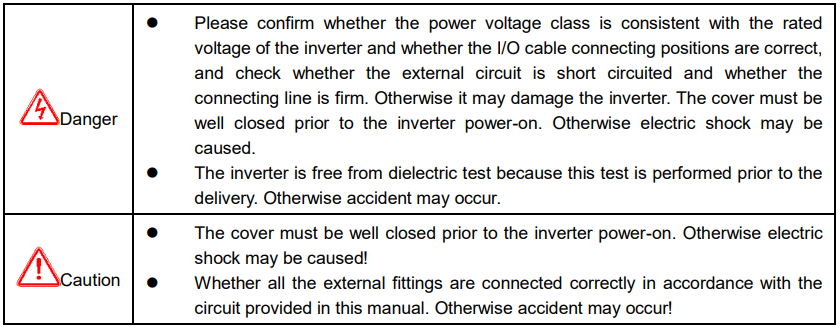
DANGER:
• Please confirm whether the power voltage class is consistent with the rated voltage of the inverter and whether the I/O cable connecting positions are correct, and check whether the external circuit is short circuited and whether the connecting line is firm. Otherwise it may damage the inverter. The cover must be well closed prior to the inverter power-on. Otherwise electric shock may be caused.
• The inverter is free from dielectric test because this test is performed prior to the delivery. Otherwise accident may occur.
CAUTION:
• The cover must be well closed prior to the inverter power-on. Otherwise electric shock may be caused!
• Check whether all the external fittings are connected correctly in accordance with the circuit provided in this manual. Otherwise accident may occur!
1.1.5 After Power-on:
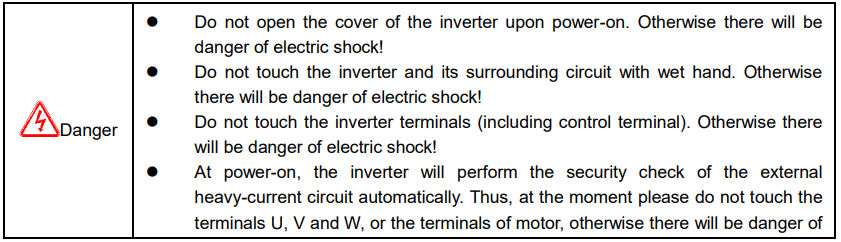

DANGER:
• Do not open the cover of the inverter upon power-on. Otherwise there will be danger of electric shock!
• Do not touch the inverter and its surrounding circuit with wet hands. Otherwise there will be danger of electric shock!
• Do not touch the inverter terminals (including control terminal). Otherwise there will be danger of electric shock!
• At power-on, the inverter will perform the security check of the external heavy-current circuit automatically. Thus, at that moment please do not touch the terminals U, V and W, or the terminals of motor, otherwise there will be danger of electric shock.
CAUTION:
• If parameter identification is required, due attention should be paid to the danger of injury arising from the rotating motor. Otherwise accident may occur!
• Do not change the factory settings at will. Otherwise it may damage the equipment!
1.1.6 During Operation:
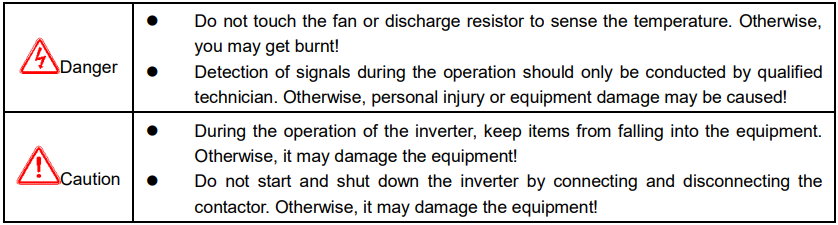
DANGER:
• Do not touch the fan or discharge resistor to sense the temperature. Otherwise, you may get burnt!
• Detection of signals during the operation should only be conducted by qualified technician. Otherwise, personal injury or equipment damage may be caused!
CAUTION:
• During the operation of the inverter, keep items from falling into the equipment. Otherwise, it may damage the equipment!
• Do not start and shut down the inverter by connecting and disconnecting the contactor. Otherwise, it may damage the equipment!
1.1.7 During Maintain:
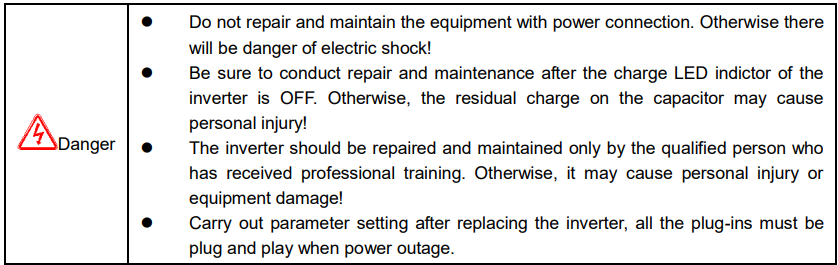
DANGER:
• Do not repair and maintain the equipment with power connection. Otherwise there will be danger of electric shock!
• Be sure to conduct repair and maintenance after the charge LED indicator of the inverter is OFF. Otherwise, the residual charge on the capacitor may cause personal injury!
• The inverter should be repaired and maintained only by a qualified person who has received professional training. Otherwise, it may cause personal injury or equipment damage!
• Carry out parameter setting after replacing the inverter; all the plug-ins must be plugged and unplugged only when the power is off.
1.2 Precautions
1.2.1 Motor Insulation Inspection
When the motor is used for the first time, or when the motor is reused after being kept, or when periodical inspection is performed, it should conduct motor insulation inspection so as to avoid damaging the inverter because of the insulation failure of the motor windings. The motor wires must be disconnected from the inverter during the insulation inspection. It is recommended to use the 500V megameter, and the insulating resistance measured should be at least 5MΩ.
1.2.2 Thermal Protection of the Motor
If the ratings of the motor does not match those of the inverter, especially when the rated power of the inverter is higher than the rated power of the motor, the relevant motor protection parameters in the in the inverter should be adjusted, or thermal relay should be mounted to protect the motor.
1.2.3 Running with Frequency higherHigher than Standard Frequency
This inverter can provide output frequency of 0Hz to 3000Hz. If the user needs to run the inverter with frequency of more than 50Hz, please take the resistant pressure of the mechanical devices into consideration.
1.2.4 Vibration of Mechanical Device
The inverter may encounter the mechanical resonance point at certain output frequencies, which can be avoided by setting the skip frequency parameters in the inverter.
1.2.5 Motor Heat and Noise
Since the output voltage of inverter is PWM wave and contains certain harmonics, the temperature rise, noise and vibration of the motor will be higher than those at power frequency.
1.2.6 Voltage-sensitive Device or Capacitor Improving Power Factor at the Output Side
Since the inverter output is PWM wave, if the capacitor for improving the power factor or voltage sensitive resistor for lightning protection is mounted at the output side, it is easy to cause instantaneous over current in the inverter, which may damage the inverter. It is recommended that such devices not be used.
1.2.7 Switching Devices likeLike Contactors Used at the Input and Output terminal
Terminal
If a contactor is installed between the power supply and the input terminal of the inverter, it is not allowed to use the contactor to control the startup/stop of the inverter. If such contactor is unavoidable, it should be used with interval of at least one hour. Frequent charge and discharge will reduce the service life of the capacitor inside the inverter. If switching devices like contactor are installed between the output end of the inverter and the motor, it should ensure that the on/off operation is conducted when the inverter has no output. Otherwise the modules in the inverter may be damaged.
1.2.8 Use underUnder voltageVoltage ratherRather than ratedRated voltage
Voltage
If the KE series inverter is used outside the allowable working voltage range as specified in this manual, it is easy to damage the devices in the inverter. When necessary, use the corresponding step-up or step-down instruments to change the voltage.
1.2.9 Change Three-phase Input to Two-phase Input
It is not allowed to change the KE series three-phase inverter into two-phase one. Otherwise, it may cause fault or damage to the inverter.
1.2.10 Lightning Impulse Protection
The series inverter has lightning over current protection device, and has certain self-protection capacity against the lightning. In applications where lightning occurs frequently, the user should install additional protection devices at the front-end of the inverter.
1.2.11 Altitude and Derating
In areas with altitude of more than 1,000 meters, the heat sinking effect of the inverter may turn poorer due to rare air. Therefore, it needs to derate the inverter for use. Please contact our company for technical consulting in case of such condition.
1.2.12 Certain Special Use
If the user needs to use the inverter with the methods other than the recommended wiring diagram in this manual, such as shared DC bus, please consult our company.
1.2.13 Note of Inverter Disposal
The electrolytic capacitors on the main circuit and the PCB may explode when they are burnt. Emission of toxic gas may be generated when the plastic parts are burnt. Please dispose the inverter as industrial wastes.
1.2.14 Adaptable Motor
1)
- The standard adaptable motor is four-pole squirrel-cage asynchronous induction motor. If such motor is not available, be sure to select adaptable motors in according to the rated current of the motor. In applications where drive permanent magnetic synchronous motor is required, please consult our company;
2) - The cooling fan and the rotor shaft of the non-variable-frequency motor adopt coaxial connection. When the rotating speed is reduced, the cooling effect will be poorer. Therefore, a powerful exhaust fan should be installed, or the motor should be replaced with variable frequency motor to avoid the over heat of the motor.
3) - Since the inverter has built-in standard parameters of the adaptable motors, it is necessary to perform motor parameter identification or modify the default values so as to comply with the actual values as much as possible, or it may affect the running effect and protection performance;
4) - The short circuit of the cable or motor may cause alarm or explosion of the inverter. Therefore, please conduct insulation and short circuit test on the newly installed motor and cable. Such test should also be conducted during routine maintenance. Please note that the inverter and the test part should be completely disconnected during the test.
Słowa kluczowe
Micno KE600, falownik, inverter, bezpieczeństwo, safety precautions, danger, caution, izolacja silnika, motor insulation, derating, wysokość, altitude, utylizacja, disposal